Guarda wallet: Setup, recovery, and features guide
Guarda wallet Is a practical guide to setup, recovery, and everyday crypto use
Guarda wallet Is a non-custodial cryptocurrency wallet for storing, sending, receiving, buying, swapping, and staking supported digital assets across desktop, mobile, web, and browser-extension environments. Its main appeal is convenience: one interface can manage many coins and tokens while keeping private-key control with the user. The most important rule is simple: protect the password, backup file, and any exported private keys, because losing them can mean losing access to funds.
Guarda wallet is often considered by users who want more control than a custodial exchange account but do not want to run separate wallet apps for every blockchain they use. It sits in the broad category of software wallets, alongside mobile wallets, desktop wallets, and browser wallets. Unlike an exchange account, Guarda wallet is designed so the user manages access credentials rather than relying on a company to reset a forgotten account in the usual web-service sense.
What is Guarda wallet?
Guarda wallet is a multi-currency crypto wallet built for people who want one place to manage assets such as Bitcoin, Ethereum, Litecoin, Dogecoin, stablecoins, ERC-20 tokens, TRC-20 tokens, BEP-20 tokens, NFTs on supported networks, and many other blockchain assets. Supported assets and features can change, so users should always confirm the current list inside the official wallet interface before sending funds.
Guarda wallet is non-custodial, which means the wallet provider is not supposed to hold the private keys needed to spend funds. The practical benefit is control: a user does not need permission from a centralized exchange to sign a transaction. The practical burden is responsibility: if the user misplaces the backup material or exposes it to a scammer, there may be no simple account recovery path.
Guarda wallet also works as an interface to several crypto actions beyond storage. Depending on region, asset, network, and partner availability, users may see options to buy crypto, swap one asset for another, stake eligible coins, create or import wallets, export individual private keys, and connect a Ledger hardware wallet for supported assets. None of these features removes the need to understand network fees, transaction finality, and blockchain-specific risks.
How does Guarda wallet work?
Guarda wallet works by generating and managing wallet data on the user side, then using that data to sign blockchain transactions. When a person sends crypto, the wallet prepares a transaction, the user reviews the recipient address and fee, and the transaction is broadcast to the relevant network after approval. Once confirmed on-chain, the transfer is generally difficult or impossible to reverse.
Guarda wallet uses a password and encrypted backup-file model that differs from the familiar 12-word or 24-word recovery phrase used by many other wallets. In ordinary use, a user creates a password and downloads a backup file that contains encrypted wallet information. The password and the backup file work together for restoration, so storing only one of them may not be enough.
Guarda wallet users should treat the backup file as sensitive financial access material, not as a casual download. The file should be stored offline where possible, ideally with more than one protected copy. If a user adds or removes wallets, imports assets, changes the password, or makes other wallet-management changes, the backup may need to be updated so it reflects the current wallet set.
Guarda wallet also allows individual private keys to be exported for supported wallets. That can be useful for advanced recovery or migration, but it is also risky. Anyone with an unencrypted private key can control the corresponding wallet. A private key should never be pasted into a chat, shared with support impersonators, stored in an email draft, uploaded to cloud storage without strong protection, or typed into an unfamiliar website.
How to get started with Guarda wallet
Guarda wallet setup is straightforward, but the security choices made during setup matter more than the clicks themselves. A new user should begin from the official source, choose the correct platform, and avoid search ads or messages that imitate a wallet download page. Crypto wallet phishing is common, and a convincing fake website can steal funds before a user realizes anything is wrong.
Guarda wallet setup generally follows a simple workflow. The exact labels may differ by platform, but the core sequence is to create the wallet, set a strong password, download the backup file, and confirm that the backup is stored safely before depositing significant value. Users should test with a small amount when using a new asset or chain for the first time.
Install or open Guarda wallet from the official source for the chosen device.
Create a new wallet and choose a long, unique password that is not reused anywhere else.
Download the encrypted backup file and store it in secure offline locations.
Add the assets or networks needed for normal use and update the backup if the wallet instructs you to do so.
Send a small test transaction before moving larger balances.
For a new user, Guarda wallet should be approached as a financial tool rather than a simple app signup. There may be no conventional forgot-password button that can restore lost self-custody access. A written password record stored securely, an encrypted USB drive, a hardware security plan, and careful device hygiene can matter more than any individual app feature.
How do you recover Guarda wallet access?
Guarda wallet recovery usually depends on having the correct backup file and the password connected to that backup. After reinstalling the app or opening the wallet on another supported platform, the user typically chooses a restore or import option, provides the backup file, enters the password, and waits for the wallet data to load. If the password is wrong or the file is outdated, recovery may fail or show only part of the expected wallet set.
Guarda wallet recovery is different from recovery in wallets that use one seed phrase for everything. Some users expect a single phrase to restore every asset, but Guarda wallet commonly centers restoration around the encrypted backup. This is why it is important to keep the backup file after meaningful wallet changes and to understand whether each asset was created, imported, or connected through a hardware wallet.
Guarda wallet users who are planning ahead may find it useful to read a broader guide before a device fails. Recovery is easiest when the user has a recent backup file, a known password, and a clear record of which assets were held. Waiting until after a laptop crash, phone loss, or browser reset often turns a simple restore into a stressful audit of old downloads and passwords.
Guarda wallet restoration should never require sending a backup file, password, or private key to a stranger. Legitimate support teams generally do not need full secret material to answer basic questions. Any person claiming that they can unlock a wallet if you provide the file and password should be treated as a serious security risk unless you have independently verified the process and understand exactly what is being shared.
What can you use Guarda wallet for?
Guarda wallet can be used for day-to-day crypto management across several common activities. A person might receive Bitcoin from an exchange, hold Ethereum and tokens, keep stablecoins for transfers, swap one asset into another through an integrated provider, or stake eligible assets from inside the wallet. The available options depend on the asset, network, jurisdiction, device, liquidity partners, and current product support.
Guarda wallet is most useful when the user understands that a wallet is an interface to blockchains, not a bank account with reversible card-style payments. Sending crypto to the wrong network, wrong token contract, or wrong address can lead to permanent loss. When using stablecoins such as USDC or USDT, users should pay close attention to the network version because the same ticker can exist on multiple chains.
Guarda wallet swaps can simplify exchanges between supported assets, but they are not fee-free magic. A swap may involve an exchange partner, a quoted rate, spread, minimum amounts, partner commissions, network gas, and settlement time. Before confirming, a user should review the asset being sent, asset being received, network, amount, estimated rate, and all displayed costs.
Guarda wallet staking may appeal to users who hold proof-of-stake assets and want to participate in network rewards, but staking has tradeoffs. Assets may be subject to bonding periods, unbonding delays, validator commission, smart contract risk, slashing risk on some networks, price volatility, and changing reward rates. Staking rewards are not guaranteed income, and users should verify details with official network and wallet sources before committing funds.
Fees and costs of Guarda wallet
Guarda wallet costs depend on the action. Creating or installing the wallet may be free, but blockchain transactions usually require network fees paid to validators or miners. Those fees vary by chain and congestion. Ethereum gas can behave very differently from Litecoin transaction fees, Bitcoin miner fees, Tron energy or bandwidth mechanics, or fees on newer smart-contract networks.
Guarda wallet may also display partner-related costs for buying, selling, swapping, card payments, or other services delivered through third parties. The user should review the final quote before approving an operation. A convenient in-app purchase can be worthwhile for some users, but the effective price may differ from an exchange order book because the service may include spreads, processing costs, or partner fees.
Guarda wallet users should also consider hidden practical costs: failed transactions, sending on the wrong network, repeated test transfers, and withdrawing from an exchange to an unsupported chain. A small amount of planning can reduce these costs. Checking the recipient address format, confirming the token standard, and leaving enough native gas token for future transactions are basic habits that prevent many avoidable mistakes.
Is Guarda wallet safe?
Guarda wallet can be safe when used carefully, but no software wallet is risk-free. The strongest feature is self-custody: the user keeps control of access credentials. The biggest weakness is also self-custody: malware, phishing, weak passwords, lost backups, compromised devices, and social engineering can all defeat good wallet design. Safety depends on both the software and the user's operating habits.
Guarda wallet users should verify downloads, keep operating systems updated, avoid browser extensions they do not trust, and be cautious with clipboard malware that swaps crypto addresses. Before sending, compare the beginning and end of the destination address. For larger transfers, send a test first. For long-term holdings, consider whether a hardware wallet is a better place to keep most funds.
Guarda wallet can connect with Ledger hardware wallets for supported assets, which may improve private-key isolation because the hardware device signs transactions without exposing keys to the computer in the same way a pure software wallet does. That does not remove all risk. Users still need to verify transaction details on the device screen, protect the hardware wallet recovery phrase, and understand which assets are actually managed through the hardware device.
Guarda wallet security also depends on support-channel discipline. Scammers often impersonate wallet staff, create fake recovery portals, or ask users to upload backup files for urgent fixes. A real support interaction should not require handing over the secrets that move funds. Users should independently navigate to official support pages and never trust unsolicited direct messages about wallet recovery.
How does Guarda wallet compare with exchanges and hardware wallets?
Guarda wallet sits between two common crypto management models. Compared with a centralized exchange, Guarda wallet gives the user more direct control over private keys and on-chain transactions. Compared with a hardware wallet used alone, Guarda wallet is usually more convenient for frequent activity, though a pure software wallet has a broader attack surface because it lives on an internet-connected device.
Option
Typical strength
Typical tradeoff
Guarda wallet
Multi-asset self-custody with convenient app features
User must protect backup file, password, and device
Centralized exchange
Easy account login, trading tools, and fiat ramps
Platform custody, withdrawal rules, and counterparty risk
Hardware wallet
Stronger private-key isolation for long-term storage
Extra device management and less convenience for frequent actions
Guarda wallet may make sense for users who want practical self-custody without juggling many separate apps. A hardware wallet may make more sense for larger long-term balances. An exchange may still be useful for active trading or fiat conversion, but leaving all funds on an exchange introduces its own custody and platform risks. Many experienced users divide funds by purpose rather than treating one tool as perfect for every situation.
Common mistakes to avoid with Guarda wallet
Guarda wallet mistakes often come from rushing. A user sees a familiar token ticker, copies an address, and sends funds before checking the network. Another user updates a wallet, adds new assets, but keeps only an older backup. Someone else responds to a recovery message and shares sensitive files. These are ordinary human mistakes, and crypto systems can be unforgiving.
Guarda wallet users can reduce risk by building a repeatable routine. Confirm the official app or website, use a password manager or secure offline record, store backup files separately from the password, keep more than one protected backup location, and test recovery with small balances before relying on the wallet for important funds. For deeper background on backup hygiene, a walkthrough can help users design a safer process.
Guarda wallet should also be used with realistic expectations. It can help organize many assets, but it cannot make volatile tokens stable, guarantee staking returns, reverse mistaken transfers, or protect a device that is already compromised. Crypto prices, network rules, validator performance, third-party services, and wallet features can change. Users should verify the current details with official sources before making financial decisions.
Who is Guarda wallet best for?
Guarda wallet is best suited to users who want a broad, self-custodial wallet and are willing to take backup security seriously. It can be practical for someone who holds several major coins, uses tokens on different networks, occasionally swaps assets, and wants access across desktop or mobile devices. It is less ideal for someone who wants a company to recover access with an ID check if credentials are lost.
Guarda wallet can also serve as a learning tool for users moving from exchange custody into direct blockchain ownership. It exposes practical concepts such as addresses, gas, token standards, private keys, staking, hardware-wallet connections, and backup files. The learning curve is manageable, but the consequences of mistakes can be real, so new users should start slowly and document their recovery process before storing meaningful value.
Guarda wallet is ultimately a convenience layer over self-custody. Its value comes from combining many wallet tasks in one interface while leaving key responsibility with the user. The sensible approach is to use Guarda wallet deliberately: verify official information, keep backups current, understand fees before confirming transactions, consider hardware storage for larger balances, and never share secrets with anyone who claims they need them to help.
Reader rating:
4.4 / 5
based on 591 ratings
Questions and Answers
What is Guarda wallet used for?
Guarda wallet is used to store, send, receive, buy, swap, and sometimes stake supported cryptocurrencies and tokens. It is a non-custodial wallet, so users manage their own access credentials instead of relying on an exchange to hold private keys. Its appeal is managing many assets in one interface, but users still need to verify supported networks, fees, and current wallet features before moving funds.
Does Guarda wallet use a seed phrase?
Guarda wallet commonly uses an encrypted backup file together with a user password rather than presenting every user with the same seed-phrase workflow used by many wallets. Some imported wallets or individual assets may have their own private-key or mnemonic details. For recovery, the important point is to keep the correct backup file, password, and any exported keys secure and current.
How do I recover a Guarda wallet?
To recover a Guarda wallet, users generally reinstall or open the wallet, choose the restore or import option, provide the correct encrypted backup file, and enter the matching password. Recovery may fail if the password is wrong, the backup file is outdated, or the file is damaged. Users should never give the backup file and password to unsolicited support contacts or recovery websites.
Is Guarda wallet safe for storing crypto?
Guarda wallet can be safe when used with strong security habits, but it is still a software wallet on connected devices. Users should verify downloads, keep devices clean, protect the backup file and password, avoid phishing links, and test transactions before sending large amounts. For larger long-term holdings, a compatible hardware wallet may reduce some private-key exposure compared with software-only storage.
What fees does Guarda wallet charge?
Guarda wallet activity can involve blockchain network fees, and some in-app services may include partner fees, spreads, card-processing costs, or swap-related costs. Fees vary by asset, network congestion, provider, and transaction type. Before confirming a transaction, users should review the displayed quote, network, gas fee, and expected amount received. Crypto transactions are usually final once broadcast and confirmed.
Can Guarda wallet connect to a Ledger hardware wallet?
Guarda wallet supports Ledger integration for certain assets and workflows, letting the wallet interface interact with accounts whose private keys remain on the hardware device. Support can vary by coin, device, app version, and platform. Users should verify the current supported asset list, confirm transaction details on the Ledger screen, and keep the hardware wallet recovery phrase separate from Guarda backup files.
What should I do before sending funds to Guarda wallet?
Before sending funds to Guarda wallet, confirm that the asset and network are supported, copy the receiving address from the correct wallet, and check both the beginning and end of the address. For tokens such as USDT or USDC, verify the chain version carefully. A small test transfer is wise when using a new network, new exchange withdrawal route, or newly created wallet.
As more people enter the cryptocurrency market, there has been an explosion of high-quality self-custodial wallet applications. Although software wallets aren’t as hack-proof as hardware wallets like KeepKey or Ledger, they are convenient and secure ways for people to take ownership of their digital assets. Plus, most of today’s top-rated software crypto wallets are free to download on desktop and mobile devices.
The Guarda Wallet is one example of a highly versatile and popular multi-blockchain software crypto wallet. Many beginners praise Guarda Wallet for its intuitive interface, simple set-up process, and bonus features like in-app crypto staking. Unlike many competing software wallets, Guarda never shows the secret mnemonic seed phrase to wallet users. Instead, the Guarda Wallet team chose to give each user a “master private key” that is encrypted with the user’s password. This makes it easier for people to store and remember this crucial information. Everyone who uses the Guarda Wallet also receives a backup file if they ever need to restore their account.
Whether you’re considering downloading the Guarda Wallet or already have an account, this guide will answer all the basic questions about setting up and using the Guarda app. We’ll also run through a few basic troubleshooting scenarios so you know how to recover your Guarda Wallet.
What Is the Guarda Crypto Wallet?
The Guarda Wallet is a software crypto wallet that works on desktop and mobile settings. When Paul Sokolov launched Guarda in 2017, this wallet only worked within Ethereum’s ecosystem. However, as Guarda’s popularity grew, it has become a multi-blockchain wallet capable of storing over 10,000 coins and tokens. In addition to Ethereum and ERC-20 tokens, Guarda Wallet users can store many prominent virtual currencies like
Bitcoin
,
Litecoin
, and
Dogecoin
.
Guarda users can purchase crypto directly with a credit or debit card or apply for Guarda’s prepaid Visa card. Guarda users also have the option to swap dozens of cryptocurrencies on the Guarda Wallet thanks to its integration with the exchange ChangeNOW. Thirdly, Guarda supports staking dozens of cryptocurrencies so investors can earn interest on their favorite projects. A few coins and tokens now available for staking rewards on Guarda include Ethereum, Cosmos, Cardano, and Tezos.
For even more security, Guarda Wallet integrates with the hardware wallet manufacturer Ledger. Anyone who has a Ledger device can link it to their PC, open their Guarda account, and select the “Connect” button near the Ledger icon. Simply choose any of the cryptocurrencies listed on your screen to connect your Ledger account to your Guarda Wallet.
Currently, Guarda supports the following digital assets through its Ledger connect feature:
Bitcoin
Ethereum
Binance Coin
Ethereum Classic
Litecoin
Callisto
Setting Up a New Guarda Wallet: A Step-by-Step Guide
The first step to creating a new Guarda account is to visit thewallet’s main website at
www.guarda.com
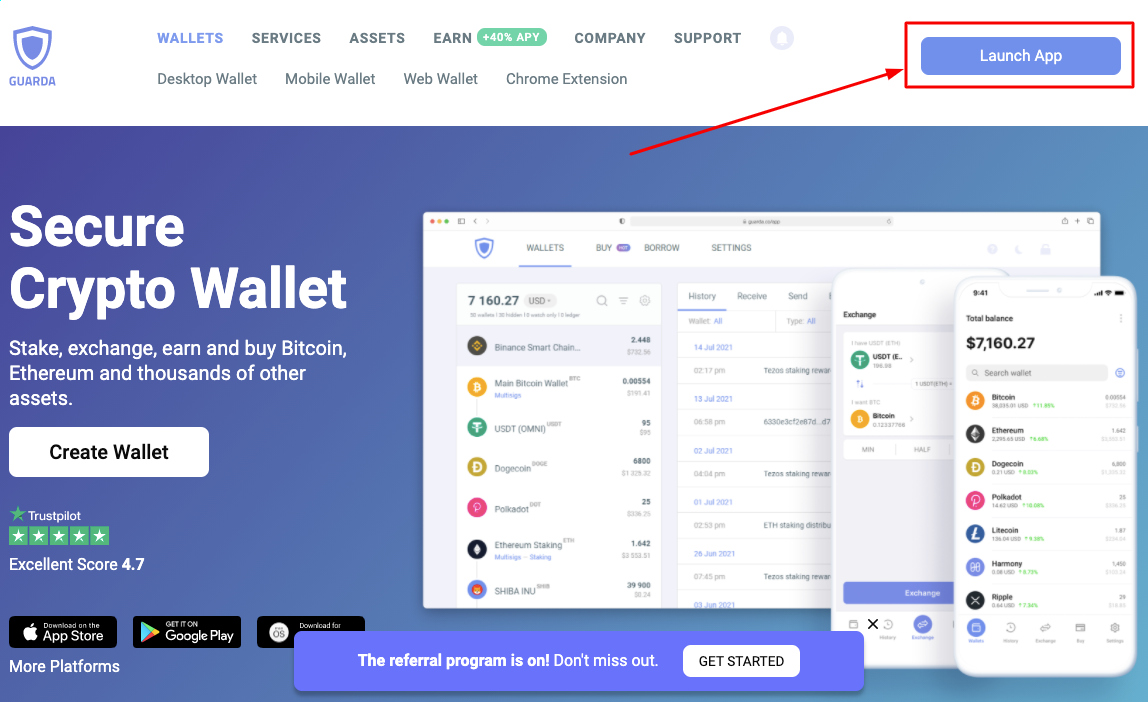
. On Guarda’s homepage, you’ll find a bright “Create Wallet” button leading you through the straightforward set-up process. According to Guarda’s website, you can download this wallet on any of the following desktop and mobile systems:
MacOS
iOS
Windows
Debian
Linux
Android
Chrome extension
AppGallery
Ubuntu
Once you’ve chosen your preferred operating system, Guarda will prompt you to create a password for your new wallet. The password you choose will automatically link to your wallet’s encrypted private key, which serves as the “master private key” for all of the crypto in your Guarda account. The master private key in your Guarda Wallet gives you complete control over the cryptocurrencies in your account, so it’s extremely important to keep it secure. Guarda asks new users to take their time creating a
strong password
and to write it down before moving on to the next step.
After writing down your password, your Guarda Wallet will supply you with a “backup file” in a TXT format. As the name suggests, the backup file contains the necessary information on your private keys, and you can use it to recover your Guarda Wallet. Download your backup file and store it in a safe place, such as an encrypted USB drive.
Once you have your secret passphrase and backup file in secure places, your Guarda Wallet should be ready for transferring, storing, staking, and purchasing cryptocurrencies. If you have any issues creating a Guarda Wallet account, consider contacting a Guarda customer care member via their
official Contacts page
.
How Do You Recover Crypto From a Lost Guarda Wallet?
As mentioned above, each Guarda wallet has two vital pieces of information:
Password
Backup file
If you break your phone or computer and need to re-download your Guarda Wallet, first visit Guarda’s official website and click either “Create Wallet” or “Sign In.” Instead of creating a new Guarda account, select “Restore or Import” to recover your lost Guarda account. On this page, you must place your backup file in the provided field and type your password. After you click the “Restore” button, your old Guarda account should appear on your computer screen or mobile device.
Can’t Get Into Your Guarda Wallet? Reach Out to ReWallet!
If you’re having difficulty recovering your Guarda Wallet, there may be ways ReWallet’s team can help you get into your account. For instance, if you have an incorrect passphrase or a corrupted backup file, it’s still possible to restore a Guarda Wallet. The only instance where ReWallet can’t help clients is if they’ve misplaced their backup file.
Anyone struggling to recover crypto in their Guarda Wallet should consider contacting professional
wallet recovery services
like ReWallet to assess their individual situation. After reading about your situation, an expert from ReWallet’s team will let you know what’s going on with your wallet and the best way to move forward.
Bruno Krauss
Co-founder and CTO Bruno is a crypto native. Long before the public hype around Bitcoin, Ethereum & Co, Bruno was already active in crypto. The idea for ReWallet originated from losing access to his own wallet.